Claude AI Explained: Architecture, Features & Real Use Cases
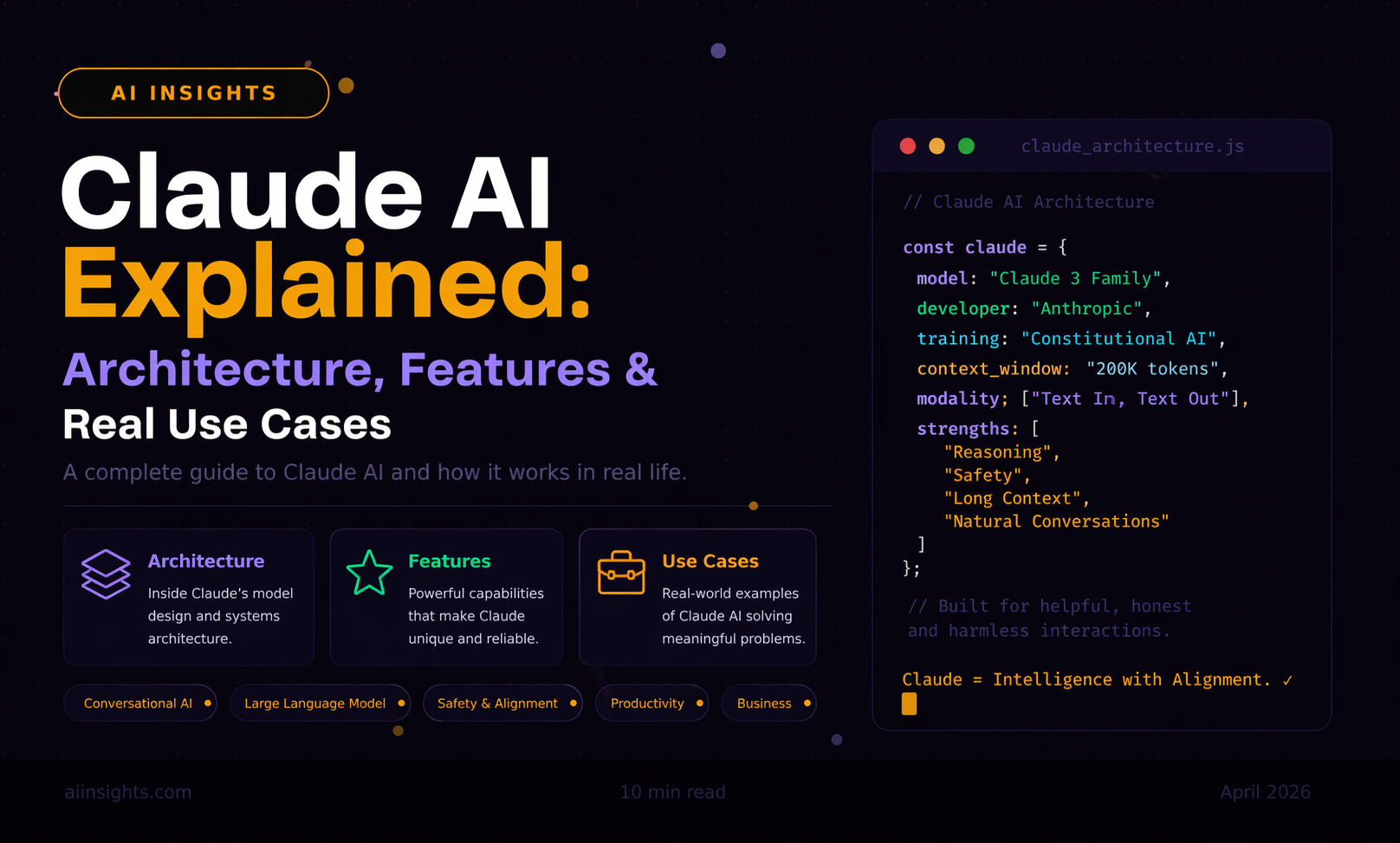
A complete guide to Claude AI — how it works, what makes it unique, and real-world examples of Claude solving meaningful problems across industries.
Claude AI Explained: Architecture, Features & Real Use Cases
Artificial intelligence has moved from a niche research topic to a mainstream productivity tool, and Claude AI is at the center of that shift. Built by Anthropic and powered by a unique training philosophy called Constitutional AI, Claude has become one of the most trusted and capable AI assistants available today. Whether you are a developer, a business owner, a student, or a curious reader, understanding what Claude is, how it works, and where it performs best can help you make smarter decisions about how to use AI in your work and daily life.
This guide covers everything you need to know — from the underlying architecture and training approach to the practical features that make Claude stand out, and the real use cases where it delivers clear, measurable results.
What Is Claude AI?
Claude is a large language model developed by Anthropic, a company founded in 2021 by former members of OpenAI. The name itself reflects Anthropic's belief in building AI that is safe, honest, and beneficial to people. Claude is not just a general-purpose chatbot. It is designed from the ground up to be a reliable assistant that reasons carefully, communicates clearly, and avoids generating harmful or deceptive content.
Unlike many AI systems that prioritize capability above everything else, Claude is built with safety as a core design principle — not an afterthought. That distinction shapes everything about how it behaves, what it will and will not do, and why users tend to trust it more over time.
The Architecture Behind Claude
At its technical core, Claude is a transformer-based large language model trained on a massive corpus of text data. This is the same architectural foundation used by GPT models and other modern AI systems. What sets Claude apart is not the architecture itself, but the training methodology applied on top of it.
Constitutional AI: The Training Philosophy
The most important thing to understand about Claude's architecture is Constitutional AI (CAI). This is Anthropic's proprietary training method, and it fundamentally changes how Claude learns to behave.
In traditional reinforcement learning from human feedback (RLHF), human reviewers rate model outputs to teach the AI what is good and bad. Constitutional AI goes further. It provides the model with a written set of principles — a "constitution" — and uses AI-generated feedback to evaluate whether responses align with those principles. The model learns to self-critique and revise its own outputs based on this constitutional framework.
The result is an AI that has internalized a coherent value system rather than just pattern-matching to human preferences. Claude does not simply avoid bad outputs because it was penalized for them in training. It avoids them because it has learned to reason about whether a response is honest, helpful, and safe.
Context Window
One of Claude's most practically significant technical capabilities is its large context window. Claude supports up to 200,000 tokens in a single conversation — roughly equivalent to a full-length novel or hundreds of pages of documents. This means users can paste entire codebases, lengthy research papers, complex contracts, or large datasets and have Claude reason across all of it at once.
Most AI systems struggle when content spans more than a few thousand words. Claude's extended context changes what is possible. Instead of working in fragments, users can work holistically — asking Claude to analyze, summarize, compare, and reason across very large bodies of information without losing track of earlier details.
Modality
Claude's primary modality is text in and text out. It excels at reading, writing, reasoning, coding, and analysis. It can process both natural language and structured data, and it handles code in virtually every major programming language with strong accuracy and explanation quality.
Key Features That Make Claude Stand Out
Claude's strengths go beyond raw capability. Several features combine to create a distinctly useful and trustworthy experience.
1. Advanced Reasoning
Claude demonstrates strong multi-step reasoning across complex domains. It can work through logical problems, weigh competing arguments, identify flaws in reasoning, and generate structured conclusions. This makes it genuinely useful for analytical tasks — not just tasks that require fluent writing.
Where many AI systems jump to confident-sounding answers, Claude tends to think through problems more carefully, acknowledge what it does not know, and flag uncertainty when appropriate. That intellectual honesty is one of the most valuable things a professional tool can offer.
2. Safety and Alignment
Claude is designed to refuse harmful requests, avoid deceptive outputs, and behave consistently whether or not it believes it is being tested. Anthropic publishes research on its alignment work and actively studies how to improve Claude's ability to be both capable and safe simultaneously.
This matters in real-world deployment. When organizations use Claude to handle sensitive workflows — customer communications, legal drafting, medical information summarization — they need confidence that the model will not go off-script or generate damaging content. Claude's safety design is directly valuable in those contexts.
3. Long Context Understanding
The ability to maintain coherent understanding across 200,000 tokens is not just a technical specification — it is a practical superpower. Users working with Claude on long documents report that it maintains context much more reliably than competing models at similar lengths. It tracks characters in a novel, references from earlier in a legal brief, or variables from a long coding session without losing the thread.
4. Natural, Nuanced Conversation
Claude is trained to communicate naturally. It adjusts its tone to fit the context — technical when you need precision, conversational when you need accessibility, concise when brevity matters, and detailed when depth is required. It does not default to bullet-point lists for everything. It can write in narrative form, match the style of a document you paste, or mirror the level of formality in your request.
This makes Claude feel less like a tool and more like a thoughtful collaborator. In extended conversations, it remembers what was discussed earlier, builds on prior points, and adapts to feedback without requiring users to repeat context.
Real-World Use Cases
Understanding Claude's architecture and features is one thing. Seeing how it performs in real situations is what makes the picture complete.
Software Development and Code Review
Claude is widely used by developers for writing, debugging, and explaining code. It can generate working code across Python, JavaScript, TypeScript, Go, Rust, SQL, and many other languages. More importantly, it explains the code it generates, which accelerates learning and reduces dependency on black-box outputs.
Developers use Claude to:
- Write boilerplate and scaffold new projects
- Debug failing functions and identify root causes
- Review code for security vulnerabilities and performance issues
- Translate code between languages or frameworks
- Generate documentation and inline comments
- Explain unfamiliar codebases at a high level
Because Claude can hold large codebases in context, it can analyze relationships between files and functions rather than working one piece at a time.
Legal and Contract Analysis
Law firms and in-house legal teams use Claude to process large volumes of documents quickly. Claude can read a complex contract, summarize the key terms, flag unusual clauses, and compare provisions across multiple agreements. It does not replace a lawyer — but it dramatically reduces the time lawyers spend on routine document review.
Use cases include:
- Summarizing terms and conditions for clients
- Identifying liability clauses, indemnity terms, and jurisdiction provisions
- Comparing two versions of an agreement to highlight changes
- Drafting standard contract sections with appropriate legal language
Research and Analysis
Academic researchers, consultants, and analysts use Claude to accelerate information-dense workflows. Claude can read a stack of papers, extract the key findings, identify contradictions between studies, and generate structured literature reviews. It can analyze datasets described in natural language, build frameworks for comparing options, and help draft research reports.
The 200,000-token context window is especially valuable here. A researcher can paste an entire academic paper or a full market report and ask precise, analytical questions about the content.
Content Creation and Marketing
Content teams use Claude to scale production without sacrificing quality. Claude can generate blog posts, newsletters, landing page copy, social media content, email sequences, and product descriptions. It maintains consistent brand voice when given examples, and it can generate multiple variations quickly for A/B testing.
Marketing teams also use Claude to:
- Analyze competitor content and identify positioning gaps
- Generate SEO-optimized outlines and article drafts
- Edit and improve existing copy for clarity and impact
- Write ad copy variants for different audiences
Education and Learning
Students and educators use Claude as a personalized tutor. Claude can explain complex topics at any level of sophistication — from a simple analogy for a beginner to a rigorous technical explanation for an expert. It can quiz students on their notes, generate practice problems, give feedback on essays, and walk through exam-style problems step by step.
Teachers use it to generate lesson plans, create differentiated materials for students at different levels, and build comprehension questions for assigned readings.
Customer Support and Business Operations
Companies integrate Claude into customer-facing workflows to handle high volumes of support queries, generate personalized responses, and summarize customer feedback. Internal teams use it to draft policies, create training materials, and process operational reports.
Because Claude is safe and consistent, it can be deployed in contexts where an unpredictable or harmful AI response would create real business risk.
Claude vs. Other AI Models
Claude competes with models like OpenAI's GPT-4o and Google's Gemini Ultra. The comparison comes down to priorities. Claude is generally regarded as the strongest option when:
- Long-document analysis is required
- Careful, nuanced reasoning matters more than speed
- Safety and reliability in sensitive contexts is a priority
- Natural, high-quality writing output is essential
Other models may edge ahead in specific capabilities like real-time web access or multimodal image generation, but Claude's combination of large context, strong reasoning, and safety-first design makes it a preferred choice for professional and enterprise use.
Who Should Use Claude?
Claude is a strong fit for anyone who works with language, ideas, and information professionally. That covers a wide range of people:
- Developers who want a coding assistant that explains its work
- Writers and content teams who need to scale production without losing quality
- Analysts and researchers who process large volumes of text
- Lawyers and consultants who need careful, reliable document analysis
- Students who want a tutor that adapts to their level
- Entrepreneurs and business owners who need a fast, capable generalist assistant
The free version of Claude provides meaningful access for everyday tasks. Claude Pro and API access unlock higher usage limits, longer context, and priority availability — features that matter for heavy professional use.
How to Get Started with Claude
Getting started with Claude is straightforward. Visit claude.ai and create a free account. The interface is clean and conversational — you simply type your request and Claude responds.
For developers and organizations looking to integrate Claude into products and workflows, Anthropic offers a robust API with clear documentation, flexible pricing, and multiple model tiers optimized for different use cases and performance requirements.
The Bigger Picture: Intelligence with Alignment
The tagline often associated with Claude — Intelligence with Alignment — captures something genuinely important. Claude is not trying to be the most powerful AI at any cost. It is trying to be the most trustworthy and useful AI for real people with real needs.
As AI becomes more deeply embedded in professional workflows, education, healthcare, legal work, and everyday decision-making, the alignment question becomes more important, not less. Claude's approach — building safety into the core of the model rather than adding guardrails on top — represents a thoughtful answer to that challenge.
Understanding Claude means understanding that the future of AI is not just about what models can do. It is equally about what they will and will not do, and why. That distinction is what makes Claude one of the most significant AI systems of this era.
Whether you use it for five minutes a day or build your entire product on top of it, Claude is worth understanding — because it represents a genuine attempt to get both sides of the equation right.
What Sets Claude Apart Long-Term
The most durable advantage Claude offers is not any single feature — it is the coherence between capability and character. Models that reason carefully and communicate honestly tend to earn deeper trust over time. For teams building products, writing sensitive documents, or making decisions with real consequences, that consistency is not a luxury. It is a requirement. Claude is worth understanding not just as a tool for today, but as a reference point for where responsible AI development is heading.