Top AI Image Generators You Must Try in 2026
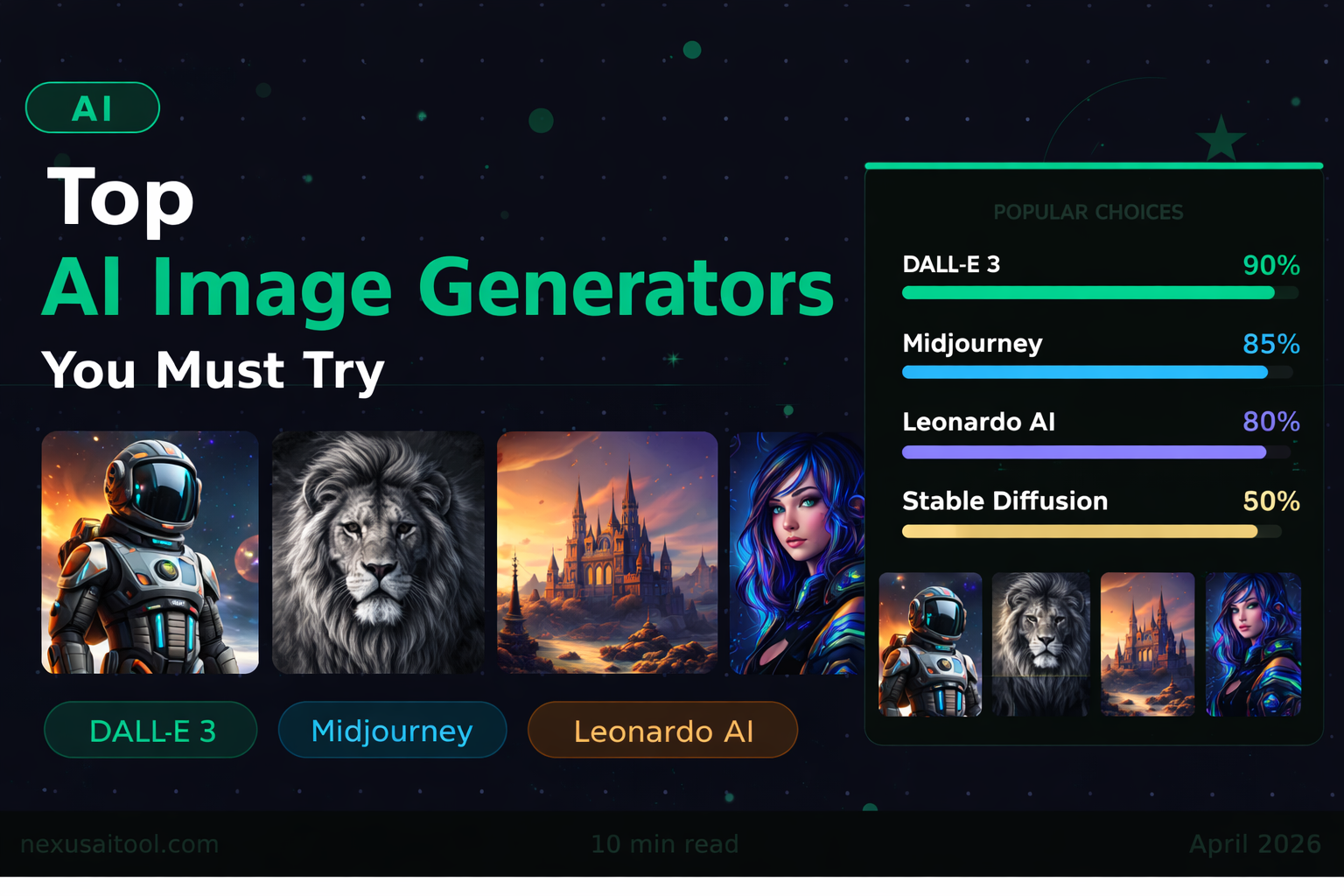
From DALL-E 3 and Midjourney to Leonardo AI and Stable Diffusion, these are the image generators worth testing in April 2026 if you care about quality, control, and practical creative output.
Top AI Image Generators You Must Try in 2026
AI image generation is no longer a side experiment for curious creators. In April 2026, it has become part of real design workflows, marketing pipelines, client presentations, concept development, social media production, and digital product creation. The biggest shift is not that these tools can make beautiful images. The real shift is that they now help people move from idea to visual draft much faster than traditional workflows alone.
That does not mean every tool is equally useful. Some platforms are better at following instructions. Some are better for cinematic art direction. Some are built for rapid experimentation. Others matter because they give you more editing control or more flexibility behind the scenes. If you choose the wrong one, you can lose hours fighting the interface, re-running prompts, or trying to force a tool into a job it was never built to do.
This guide breaks down four of the most popular AI image generators you should seriously try in 2026: DALL-E 3, Midjourney, Leonardo AI, and Stable Diffusion. These are not the only tools in the market, but they represent four different strengths. If you understand where each one shines, you can choose faster and create better work.
1. DALL-E 3 for prompt accuracy and quick ideation
DALL-E 3 remains one of the easiest entry points for people who want strong results without learning a complicated command system. Its biggest advantage is instruction following. When you describe a scene clearly, it tends to respect the brief more directly than many other tools. That matters when you are creating marketing concepts, editorial visuals, storyboards, thumbnails, or branded ideas that depend on specific objects, composition cues, or text inside the image.
Another major strength is workflow simplicity. Many users interact with DALL-E through ChatGPT, which means the process feels conversational rather than technical. You can describe the image, ask for revisions in natural language, and keep refining without jumping through a complex interface. For non-designers, that can be the difference between actually using an image tool and abandoning it after one session.
DALL-E 3 is especially useful for:
- Creative brainstorming
- Blog and social media visuals
- Product concept mockups
- Images that need readable signage or text elements
- Teams that want fast iteration without a steep learning curve
Its main limitation is that it is not always the strongest choice when you want deep stylistic control or highly personalized visual identity over many iterations. It is excellent for speed and clarity, but many advanced artists still want more control than it naturally offers out of the box.
If you care about convenience, understandable prompting, and reliable first drafts, DALL-E 3 is still one of the first tools worth trying.
2. Midjourney for style, mood, and standout aesthetics
Midjourney continues to hold a strong reputation among creators who want images that feel dramatic, polished, and visually rich. If DALL-E 3 is often praised for obedience to the prompt, Midjourney is usually praised for aesthetic taste. It tends to produce outputs that feel more cinematic, more atmospheric, and more editorial right from the first generation.
That makes Midjourney especially attractive for:
- Brand moodboards
- Fantasy and sci-fi artwork
- Poster concepts
- Visual storytelling
- Fashion, beauty, and lifestyle campaigns
- High-impact social and ad creative
One reason Midjourney stays relevant is that it is not just about raw generation quality. The platform has also expanded its editing and personalization features, which helps users shape output around a preferred visual style. For creators who know what they like aesthetically, this matters a lot. A tool that understands your taste can save hours of prompt rewriting.
Midjourney is a strong choice when the question is not just "can this model make the image?" but "can this image feel premium enough to present to a client or audience?" It often performs well when emotion, lighting, visual drama, and texture matter more than strict factual precision.
The tradeoff is that Midjourney can feel less straightforward for beginners than a conversational tool. New users sometimes need time to learn how the platform thinks. It is also easy to generate beautiful images that are slightly off-brief if you do not direct it carefully. In other words, Midjourney rewards taste and experimentation.
If your work depends on strong artistic direction, it deserves a place near the top of your list.
3. Leonardo AI for production workflows and creator-friendly tooling
Leonardo AI has become popular because it sits in a practical middle zone. It is not just about generating a pretty image once. It is about helping creators move through a fuller workflow. That is why it appeals to marketers, game asset creators, content teams, ecommerce operators, and freelancers who need more than raw inspiration.
Leonardo AI is often appreciated for features that support repeated production work, including model variety, workflow flexibility, and tools that help with iterative editing. It fits well for people who want to create character sets, marketing assets, concept visuals, design references, or image variations at scale without feeling trapped in a single style.
This makes Leonardo AI useful for:
- Content teams producing image sets
- Freelancers creating client options
- Game and character design exploration
- Ad creative testing
- Thumbnail and visual asset production
- Creators who want more control without going fully technical
Another reason Leonardo AI stands out is usability. It often feels more approachable than deeply technical open workflows while still giving you more room to shape and refine the result than simple one-shot tools. That balance is valuable for people who want control but do not want to build an entire local pipeline.
Leonardo AI may not always have the same brand recognition as DALL-E or Midjourney, but it has earned attention by being practical. In real work, practical tools often win. If you need a platform that supports volume, experimentation, and repeated creative production, Leonardo AI is one of the smartest tools to test.
4. Stable Diffusion for maximum control and open-ended customization
Stable Diffusion remains the most important option for users who care about openness, customization, and technical freedom. While other platforms focus on polished consumer experiences, Stable Diffusion matters because it can be adapted to many different workflows. You can run variants locally, build around community tools, experiment with custom models, and use specialized controls for composition, editing, and structure.
That flexibility is why Stable Diffusion still matters in 2026. It is not just a single product. It is more like an ecosystem.
Stable Diffusion is especially strong for:
- Advanced users who want control over the pipeline
- Developers building image features into products
- Artists experimenting with custom checkpoints or style systems
- Privacy-sensitive workflows
- Teams that need image editing, inpainting, or structure control
- Users who want to balance quality with infrastructure choice
Recent Stability AI positioning also reinforces this advantage. The broader Stable Diffusion family emphasizes multiple model sizes, editing services, and deployment flexibility. That is useful if you want to create images in a way that matches your hardware, your stack, or your commercial environment rather than depending on one fixed interface.
The obvious downside is complexity. Stable Diffusion is powerful, but it asks more from the user. If you are brand new and just want a great image in one minute, it may feel overwhelming compared with more guided tools. But if you want to build a serious, controllable image workflow, there is a reason Stable Diffusion remains such a central name in the space.
How these four tools compare in practice
If you strip away the hype, the four platforms usually win for different reasons:
- DALL-E 3 wins on ease of use and prompt adherence
- Midjourney wins on style, atmosphere, and premium-looking visuals
- Leonardo AI wins on creator workflow balance and production practicality
- Stable Diffusion wins on flexibility, extensibility, and technical control
This is why asking "which one is best?" is often the wrong question. A better question is "best for what?"
For example, a blogger or startup founder may get the fastest value from DALL-E 3 because they need quick visuals and simple revisions. A creative director may prefer Midjourney because visual taste matters more than rigid prompt accuracy. A freelancer producing many asset variations may lean toward Leonardo AI. A builder creating an internal workflow, or a power user who wants custom control, may prefer Stable Diffusion.
Which AI image generator should you try first?
If you are choosing only one starting point, use this simple filter:
Start with DALL-E 3 if:
- You want the smoothest beginner experience
- You care about natural-language revisions
- You need fast drafts for marketing, content, or concept work
Start with Midjourney if:
- You want the most visually striking artistic output
- You work in branding, storytelling, or campaign design
- You already have some creative taste and want to push aesthetics
Start with Leonardo AI if:
- You produce many visual assets regularly
- You want a platform that feels practical for recurring work
- You need more workflow flexibility without going fully technical
Start with Stable Diffusion if:
- You want deeper control than closed platforms usually allow
- You are comfortable experimenting with tools and settings
- You care about customization, deployment choice, or open workflows
A smart workflow is better than tool loyalty
One mistake many creators make is becoming emotionally loyal to one platform too early. In reality, the strongest creative teams often mix tools. They may ideate in one platform, refine in another, and edit or upscale elsewhere. What matters most is not defending a favorite brand. What matters is building a workflow that gets you to a strong final visual efficiently.
For example, you might use DALL-E 3 to clarify an idea quickly, Midjourney to explore a more stylized direction, Leonardo AI to generate multiple production-ready variants, and Stable Diffusion for deeper edits or specialized control. That kind of flexible workflow often produces better results than trying to force every project through the same system.
Final thoughts
As of April 2026, AI image generation is mature enough that choosing the right tool can meaningfully affect speed, quality, and creative confidence. DALL-E 3, Midjourney, Leonardo AI, and Stable Diffusion each deserve attention, but for different reasons. The right choice depends on whether you value prompt accuracy, visual drama, production efficiency, or technical freedom.
If you are serious about improving your creative output, do not just read comparisons. Test at least two of these platforms with the same brief. Give each one a real-world task such as a blog cover, ad concept, product visual, YouTube thumbnail, or landing page illustration. Compare not only the final image, but also how fast you got there, how easy revisions felt, and how much control you had over the result.
That is the real benchmark. The best AI image generator is the one that helps you turn ideas into strong visuals with the least friction and the most confidence.
The Smart Way to Choose
The best image generator is not always the one with the loudest hype. It is the one that fits your workflow, budget, revision speed, and control needs. Teams that test tools against real use cases instead of chasing rankings alone usually get better creative output and more reliable results.