How to Spot AI-Generated Content in 2026: A Practical Guide for Editors, Teachers, and Hiring Managers
AI-generated content is everywhere in 2026. This practical guide gives editors, teachers, and hiring managers 12 proven red flags, free detection tools, and a step-by-step verification workflow to identify AI writing with confidence.
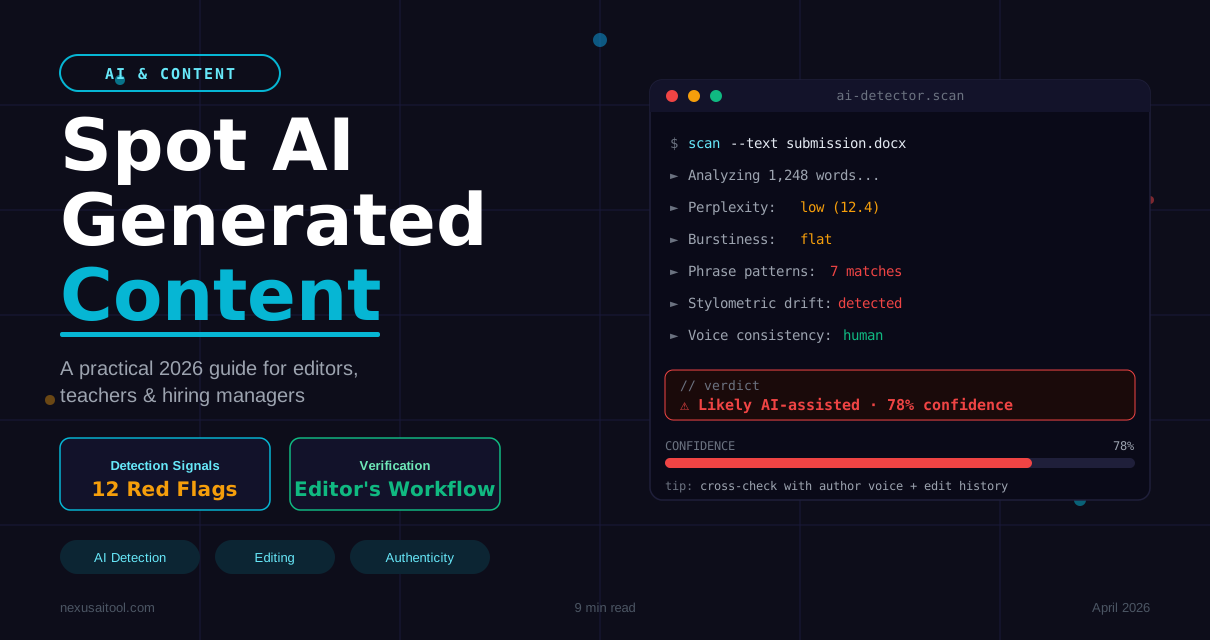
How to Spot AI-Generated Content in 2026: A Practical Guide for Editors, Teachers, and Hiring Managers
AI-generated content has become a baseline reality in 2026. It appears in student essays, job applications, freelance submissions, blog posts, marketing copy, and news articles. Most of it is not labeled. Some of it is excellent. A large portion of it is indistinguishable to a casual reader — but not to a trained eye.
This guide is for the people who need to tell the difference: editors vetting submissions, teachers evaluating student work, and hiring managers reading cover letters. You do not need expensive software or a computer science degree to develop reliable detection instincts. What you need is a framework for what to look for, a set of free tools to cross-check your judgment, and a repeatable workflow you can apply in under ten minutes.
Why Spotting AI Content Matters More in 2026
In 2023, AI writing was easy to catch. It was stiff, generic, and full of phrases like "certainly" and "as an AI language model." The models have improved dramatically since then. GPT-4o, Claude 3.7 Sonnet, and Gemini 1.5 Pro can now produce writing that sounds confident, varied, and surprisingly personal.
The problem is not that the writing is bad. The problem is that it is often hollow — structurally correct, tonally appropriate, but missing the lived experience, specific knowledge, and editorial judgment that distinguish authentic human work from statistically assembled text.
For editors, that means accepting content that will bore readers and fail to build trust. For teachers, it means crediting students for learning they did not actually do. For hiring managers, it means hiring someone whose communication style on the job will look nothing like their application.
Detection is not about paranoia. It is about maintaining standards.
The 12 Red Flags of AI-Generated Content
1. Flat Burstiness
Human writing has natural rhythm variation. Short punchy sentences appear next to longer, winding ones. AI output tends toward uniform sentence length — paragraph after paragraph of similarly structured, mid-length sentences with minimal variation. This is called "low burstiness" and it is one of the most reliable signals detectors measure.
2. Low Perplexity
Perplexity measures how predictable the next word is, given the words before it. AI models generate the most statistically likely continuations of text. That produces writing that feels smooth but never surprising. Human writers make unexpected word choices, use metaphors, and occasionally violate expectations deliberately. If you read a piece and nothing surprises you — not a word choice, not a turn of phrase, not a structural decision — that is a signal.
3. Generic Transitions and Filler Phrases
Watch for transitions like "It is worth noting that," "In today's fast-paced world," "This is especially true when," and "Let's explore this in more detail." These are AI comfort phrases — statistically common in training data and overused by default. Human writers tend to develop idiosyncratic transitions. AI writers default to the median.
4. No Personal Anecdotes or Specific Examples
Authentic writing is full of specific detail: a particular incident, a named colleague, a specific city, a precise date. AI-generated content tends to stay at the level of generality. It will say "many businesses have found success" rather than naming one. It will say "researchers have shown" without citing who or when. Absence of specificity across an entire piece is a strong indicator.
5. Overly Balanced "On the Other Hand" Structures
AI models are trained to present multiple perspectives in a balanced way. Human writers have opinions. If every section of a piece presents a counterargument and then politely dissolves it, and the author never commits to a clear position, the text was likely not written by someone with a genuine stake in the argument.
6. Hedge-Heavy Language
Phrases like "it may be argued," "some might say," "this could potentially," and "it is possible that" appear at much higher rates in AI text than in confident human writing. A single instance is fine. An entire piece built on hedges suggests the model was avoiding commitment to claims it could not verify.
7. No Stylometric Drift
Human writers change slightly across sections. Their energy shifts. They get more casual in places they find interesting and more formal in places they find technical. AI text tends to maintain the same tone, vocabulary level, and syntactic complexity from the first paragraph to the last. Uniform consistency across thousands of words is unnatural.
8. Passive Voice Overuse
AI models default to passive constructions when attributing actions is complicated. "It has been found that" rather than "The Stanford study found." "Mistakes were made" rather than assigning responsibility. A high frequency of passive voice is not proof of AI authorship, but combined with other signals, it strengthens the case.
9. Identical Paragraph Architecture
Read the opening sentence of five consecutive paragraphs. If each one follows the same pattern — topic sentence, two supporting sentences, transition — the structure is suspiciously formulaic. AI models learned from millions of documents that follow standard essay format. Human writers break pattern, use single-sentence paragraphs, or start mid-thought.
10. Abstract Claims Without Friction
Good writing contains moments of tension: the author pushing back against themselves, acknowledging complications, or noting where the evidence does not fully support the argument. AI writing tends to be frictionless — claim, support, conclusion, move on. Nothing resists. Everything agrees. If the content reads like a press release written by an algorithm trying to be helpful, it probably was.
11. Factual Hallucinations
AI models invent statistics, quotes, studies, and publications with high confidence. If a piece cites a "2024 McKinsey study" or a "Harvard Business Review survey" with specific numbers, verify those citations. If they do not exist or the numbers are wrong, the content was almost certainly AI-generated and the author did not check it.
12. Voice Inconsistency With Other Samples
If you have other writing from the same author, compare. Does the vocabulary match? The sentence length? The tendency toward metaphor or abstraction? The way they handle objections? Writers are remarkably consistent across topics. If the submission sounds like a completely different person from their previous work, that inconsistency deserves investigation.
For Editors: Building a Detection Workflow
Step 1 — Read for feel, not content. Your first pass should ignore what the piece is saying and focus on how it reads. Does anything surprise you? Does the author seem to have a stake in the argument? Are there moments of genuine personality?
Step 2 — Check for specificity. Highlight every claim that names a specific person, study, date, or event. If there are fewer than three in a 1,000-word piece, that is unusual for strong editorial work.
Step 3 — Run a free detection tool. GPTZero and Originality.ai offer credible detection scores. Neither is conclusive alone, but a score above 80% AI probability combined with the qualitative signals above is a strong case.
Step 4 — Ask author-specific questions. Email the author and ask: "Can you walk me through your research process for this piece?" or "What did you cut that you wish you could have included?" These questions are easy for a human who wrote the piece and very difficult for someone who prompted it into existence.
Step 5 — Check edit history if possible. Google Docs revision history shows a piece being written in real time — typed in chunks with pauses, revisions, and backtracking. A single paste event followed by light editing is a strong signal.
For Teachers: Catching AI in Student Work
Compare against in-class samples. Every teacher should have a writing sample from each student produced under controlled conditions. The comparison between that sample and a take-home submission often makes AI use obvious.
Use oral follow-up. Ask the student to explain a specific argument from their essay in their own words, or to expand on a particular section verbally. Students who wrote the work can do this comfortably. Students who submitted AI output often cannot.
Design assignments that defeat AI. Ask students to include specific examples from class discussion, reference a conversation that happened in room 204 on a particular Tuesday, or draw on an interview they conducted themselves. AI cannot fabricate those details credibly because you know what actually happened.
Detect AI-rewritten work. Sophisticated students do not paste raw AI output — they run their own draft through AI for polish, or they heavily edit the AI version. This produces subtler signals: unusually clean grammar in students who previously struggled, sudden expansion of vocabulary, or complete elimination of the errors that characterized their earlier work.
For Hiring Managers: AI in Applications and Portfolios
Red flag: the cover letter sounds better than the interview. This is the clearest signal in hiring. If a candidate writes with polish and specificity in their letter but communicates in vague, incomplete sentences in person, the letter was AI-assisted.
Check for generic company knowledge. AI-generated cover letters often include lines like "Your company's commitment to innovation and excellence" — phrases that could apply to any employer. A human who actually researched the role mentions specific products, recent news, or named team members.
Audit portfolio consistency. If writing samples in the portfolio are available from different years or contexts, compare them. Look for the same stylometric signals you would look for in editorial submissions. A sudden jump in quality in the most recent samples warrants a conversation.
Ask for a live writing sample. A short written exercise completed under a time constraint during the interview process provides a direct comparison point. It does not need to be long — five sentences on why they want the role. The gap between that sample and the polished application often tells you everything.
Free Tools Worth Knowing in 2026
| Tool | Best For | Cost |
|---|---|---|
| GPTZero | Editorial and academic detection | Free tier available |
| Originality.ai | High-volume content auditing | Paid, per-credit |
| Copyleaks | Plagiarism + AI hybrid detection | Free trial |
| Winston AI | Education-focused detection | Free + paid plans |
| Sapling | Quick single-document checks | Free |
None of these tools is definitive. They produce probability scores, not verdicts. Use them as one signal in a wider qualitative review, not as a standalone judgment.
The Human Element Still Wins
The strongest detection method in 2026 is not any tool — it is a skilled human reader who has seen a lot of genuine writing and a lot of AI output. The more you read both, the better your pattern recognition becomes.
AI content has gotten dramatically better at passing automated detectors. It has not gotten dramatically better at passing the test of someone who cares deeply about authentic communication. The flat affect, the absence of friction, the inability to be genuinely wrong about anything — these qualities persist even as fluency improves.
Detection is not about finding proof for a disciplinary process. It is about maintaining the editorial and educational standards that make reading, learning, and hiring trustworthy. The people who get good at this in 2026 will have a significant professional advantage as AI-assisted content continues to proliferate.
Explore NexusAI's full suite of AI tools to understand what AI can and cannot do — knowing the tools from the inside is one of the best ways to spot their output from the outside.