Future of AI in Pakistan 2026 and Beyond
Pakistan is entering a new AI phase shaped by freelancing, education, fintech, healthcare, and startup growth. Here is what the next wave could realistically look like and where the biggest opportunities are forming.
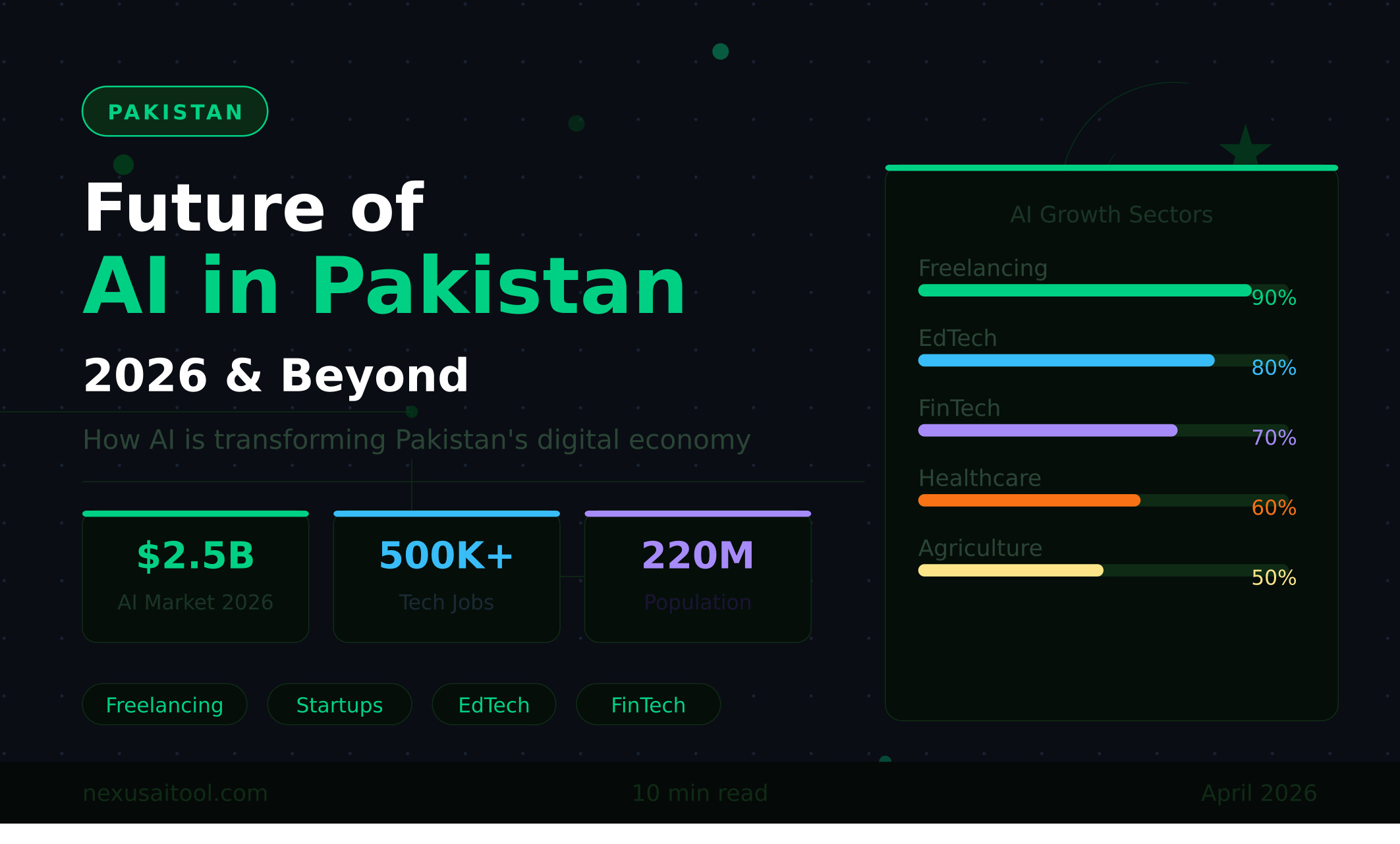
Future of AI in Pakistan 2026 and Beyond
Pakistan is moving into a period where artificial intelligence is no longer just a global headline. It is becoming a local business tool, a career lever, and a national competitiveness issue. For years, most conversations around AI in Pakistan were aspirational. People discussed what might happen if better infrastructure, better training, and better startup support arrived. In 2026, the conversation is more concrete. AI is already affecting how freelancers win clients, how students study, how startups build products, and how businesses think about automation.
The future of AI in Pakistan will not look identical to Silicon Valley, London, or Shenzhen. The country's strongest AI opportunities are tied to its own economic structure: a large young population, a strong services economy, a globally connected freelance workforce, a cost-sensitive business environment, and growing pressure to digitize education, finance, and public services. That combination creates a different roadmap. Pakistan may not lead in foundation model research, but it can absolutely become a major adopter and builder of AI-powered services.
Why Pakistan Is Well Positioned for Practical AI
The most important thing to understand is that AI does not only reward countries that build the underlying models. It also rewards countries that can apply those models quickly in high-demand sectors. Pakistan already has several structural advantages:
- A large youth population that adapts quickly to new software tools
- One of the world's strongest freelancing communities
- Growing startup activity in fintech, commerce, logistics, and education
- A clear need for productivity gains in both private and public sectors
- A bilingual and multilingual environment that increases demand for local language AI tools
These conditions matter because the first wave of AI value often comes from adoption, not invention. Businesses do not need to train frontier models to get results. They need workflows that save time, reduce errors, improve customer support, and open up new revenue streams. That is exactly where Pakistani builders can compete.
Freelancing Will Be One of the Biggest AI Growth Engines
Pakistan's freelance economy is already a major digital asset. Writers, designers, marketers, developers, virtual assistants, and video editors are under constant pressure to deliver faster without sacrificing quality. AI helps directly with that challenge.
Freelancers are using AI to:
- Draft proposals and client outreach faster
- Research industries and competitors in less time
- Produce first drafts for blogs, email sequences, and landing pages
- Generate design concepts and visual references
- Summarize client calls and extract action items
- Speed up debugging, documentation, and testing for software work
This matters at scale. If thousands of freelancers can increase output by even twenty to thirty percent while improving polish, that changes income potential across the market. It also pushes freelancers up the value chain. Instead of selling raw labor, they can sell packaged outcomes such as SEO content systems, AI-assisted design sprint services, and automated reporting workflows.
By 2026 and beyond, the strongest freelancers in Pakistan will not market themselves as people who "use AI." That will be too basic. They will market themselves as specialists who use AI to deliver faster turnarounds, clearer strategy, and better business results.
Education Is the Long-Term Multiplier
If there is one sector that can shape Pakistan's long-term AI future more than any other, it is education. AI tutoring, personalized practice, adaptive assessments, and multilingual learning assistance can improve access and outcomes if implemented carefully. In a country where quality education is unevenly distributed, intelligent learning tools can help narrow some gaps.
There are several realistic use cases:
- AI study assistants for exam preparation
- English writing and communication feedback tools
- Urdu and regional language support for explanations
- Lesson planning support for teachers
- Automated quiz generation and revision materials
- Career guidance tools for students entering digital fields
The opportunity is not just academic. Better AI-enabled education can create a pipeline of job-ready workers for software, support, sales, marketing, operations, and digital entrepreneurship. It can also help students in smaller cities access guidance that was previously concentrated in major urban centers.
That said, adoption must be responsible. Schools and universities need clear rules around plagiarism, over-reliance, and fact-checking. The best educational AI systems support understanding. They should not replace original thinking.
Fintech and Digital Commerce Could Accelerate Fast
Pakistan's digital financial ecosystem has expanded rapidly over the last few years, and AI can strengthen it even further. Fintech companies can use AI for fraud detection, customer support automation, onboarding flows, credit analysis, and smarter user education. E-commerce businesses can use it for catalog optimization, ad creative generation, customer segmentation, and demand forecasting.
For consumers and small businesses, this can mean better service and faster access. For companies, it can mean lower support costs and stronger conversion rates. AI is especially useful in environments where teams need to serve large customer bases with limited human bandwidth.
Startups in Pakistan can use AI to:
- Detect suspicious transactions earlier
- Route customer queries with better accuracy
- Generate product recommendations
- Translate and localize product experiences
- Improve merchant onboarding and compliance workflows
The companies that win will be the ones that treat AI as infrastructure, not decoration. A flashy chatbot alone will not create long-term value. Better underwriting, faster support resolution, and stronger trust signals will.
Healthcare and Agriculture Are High-Impact Areas
Some of the most meaningful AI applications in Pakistan may emerge outside the usual software circles. Healthcare and agriculture are two sectors where better information can create real downstream impact.
In healthcare, AI can support:
- Preliminary triage systems
- Medical transcription and administrative automation
- Appointment and patient communication workflows
- Decision support for non-specialist staff
- Health education content in simpler language
In agriculture, AI can help with:
- Weather-linked crop planning
- Pest and disease detection from images
- Supply chain forecasting
- Soil and irrigation recommendations
- Market price intelligence for farmers and distributors
These use cases require care, domain expertise, and human oversight. They are not places for blind automation. But they represent the kind of practical AI that can improve both economic output and daily life.
The Startup Opportunity Is Bigger Than It Looks
Pakistan does not need ten thousand generic AI wrappers. It needs products that solve local problems clearly. This is where founders have room to build.
Promising directions include:
- AI tools for small business bookkeeping and customer communication
- Local language voice assistants
- Recruitment screening and skills assessment products
- AI sales support for service businesses
- Academic support platforms for schools and coaching centers
- Workflow software for agencies and freelancers
The strongest founders will combine three things: local insight, distribution discipline, and a realistic cost structure. Many global AI products are built for Western pricing and Western workflows. Pakistani founders can win by building for local buying power, local language needs, and local business habits.
The Biggest Constraints Pakistan Must Address
Optimism is useful, but realism matters more. Pakistan's AI future will depend on how well it handles several constraints:
1. Skills gap
Many people are excited about AI, but far fewer know how to use it effectively in work settings. Prompting is the easy part. Workflow design, verification, and business application are the harder parts.
2. Infrastructure and access
Internet reliability, cloud costs, device quality, and payment friction still shape who can participate fully in the AI economy.
3. Trust and quality
AI-generated misinformation, low-quality content spam, and exaggerated claims can slow adoption if users stop trusting outputs.
4. Policy and governance
Pakistan will need clearer conversations around privacy, data use, educational integrity, and responsible deployment in sensitive sectors.
5. Leadership mindset
Many organizations still see AI as a novelty. The real gains will come when leaders redesign processes instead of layering AI on top of outdated workflows.
What 2026 and Beyond Could Look Like
A realistic near-future scenario for Pakistan is not full automation everywhere. It is widespread augmentation. Small teams become more productive. Freelancers earn more per hour. Students get better support. Startups launch leaner. Service businesses respond faster. More people in second-tier cities participate in digital work.
Over the next few years, we are likely to see:
- More AI-assisted freelance agencies and solo consultants
- Higher demand for AI-literate marketers, writers, analysts, and developers
- More localized SaaS products using AI behind the scenes
- Greater use of AI in tutoring, admissions support, and career coaching
- Better internal automation in fintech, e-commerce, and customer service teams
- A stronger divide between workers who know how to direct AI and those who only consume it passively
That final point is especially important. AI will not remove the value of human work. It will increase the value of judgment, communication, and problem framing. People who can define the task, verify the result, and connect output to business goals will have an advantage.
How Pakistan Can Build a Stronger AI Future
If Pakistan wants to turn AI momentum into durable opportunity, several moves matter:
- Teach applied AI, not just theory. Training should include workflows for writing, analysis, coding, sales, support, and entrepreneurship.
- Build local-language tools and datasets. Urdu and regional-language support will expand adoption dramatically.
- Support startup experimentation in education, finance, healthcare, and operations.
- Encourage ethical standards early so trust grows alongside usage.
- Help small businesses adopt AI in simple, useful ways instead of overwhelming them with hype.
Final Thoughts
The future of AI in Pakistan is not a distant idea anymore. It is already unfolding through small, practical wins across the economy. The country may not dominate model training, but it can absolutely become a serious force in AI-enabled services, digital work, and applied innovation.
The next chapter belongs to people who can turn tools into outcomes. In Pakistan, that means freelancers who level up their service, startups that solve local problems, educators who improve learning access, and operators who use AI to make businesses run better. If that momentum continues, 2026 and the years after it could mark the beginning of Pakistan's most important digital growth cycle yet.
Why This Shift Matters for Pakistan
Pakistan does not need to copy every global AI trend to win. The bigger opportunity is to use AI in places where the country already has energy: freelancing, services, education, small business, and fast-moving digital adoption. The teams that combine local context with practical execution will shape the strongest outcomes.