AI vs Human Work: What AI Should Do, What Humans Should Keep, and Why the Best Results Use Both
AI vs human is the wrong battle. The better question is which tasks belong to AI, which belong to people, and how to combine both for faster and better outcomes.
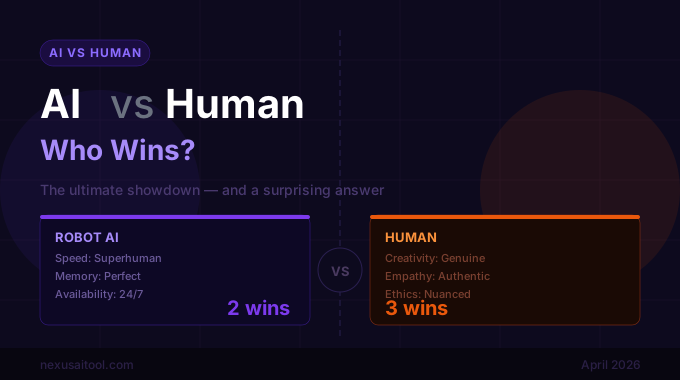
AI vs Human Work: What AI Should Do, What Humans Should Keep, and Why the Best Results Use Both
The phrase "AI vs human" makes the conversation sound like a competition with one eventual winner. That framing is catchy, but it is not especially useful. In real workplaces, the more practical question is not whether AI beats people. It is which parts of work are best handled by AI, which parts still require human judgment, and how the two can work together without creating confusion or lowering quality.
AI is incredibly good at speed, repetition, and pattern-based output. Humans are still far better at context, responsibility, emotional intelligence, values, and decisions that carry consequences. Once you understand that division clearly, the conversation becomes less dramatic and much more actionable.
Where AI is stronger than humans
AI has clear advantages in tasks that are repetitive, format-heavy, or dependent on rapidly producing many variations.
1. Speed at first drafts
AI can produce a rough draft of an email, outline, product description, blog section, or meeting recap in seconds. A human may still improve it significantly, but the initial generation speed is unmatched.
This matters because many knowledge tasks are slowed down by setup friction. Once AI gives you a working draft, you can react, edit, and refine instead of starting from zero.
2. Processing large amounts of text quickly
Humans are capable of deep reading, but they are not fast at scanning hundreds of pages for themes, repeated language, or structural patterns. AI can summarize, cluster, and extract information from large text sets much faster.
That makes it useful for:
- transcript analysis
- document summaries
- customer feedback grouping
- research organization
- content repurposing
3. Consistency across repeated tasks
Humans get tired. Tone changes. Steps are skipped. Details get lost when the workload is high. AI is helpful in repeated workflows where consistency matters more than originality.
Examples include:
- support reply templates
- formatting descriptions
- converting notes into standard summaries
- producing variant ad copy
- categorizing inputs by theme
4. Pattern recognition at scale
AI models are trained to detect patterns across large data sets and language examples. In some situations, they can surface connections people might miss because the volume is too high or the pattern is too subtle.
That does not mean AI always understands what the pattern means. But it can often help identify where a human should look.
Where humans are still stronger than AI
The most important human strengths are often the ones people notice only when they are missing.
1. Judgment under uncertainty
AI can generate options, but it does not carry responsibility for consequences. Humans do. When tradeoffs are unclear, stakes are high, or values are involved, human judgment matters more than model fluency.
A manager deciding how to handle a team conflict, a doctor interpreting a complex case, a founder choosing whether to enter a risky market, or an editor deciding whether a claim is responsible to publish is doing more than pattern matching. They are weighing context, risk, ethics, timing, and accountability.
2. Trust and relationships
People do not build trust with a system in the same way they build trust with another person. Trust comes from care, credibility, reliability, and emotional awareness over time.
AI can support relationship work by preparing notes or drafting messages, but the relationship itself is still human. In sales, leadership, coaching, therapy, recruiting, teaching, and client management, the quality of human connection often changes the outcome more than the efficiency of the process.
3. Original perspective
AI can remix patterns from its training. Humans can bring lived experience, point of view, intuition, and genuine taste. Those qualities matter in strategy, leadership, storytelling, brand building, and any work where differentiation matters.
This is why purely AI-generated work often feels technically acceptable but forgettable. It may be clear. It may even be competent. But it often lacks the texture that makes people remember, trust, or care about it.
4. Accountability
When something goes wrong, someone has to answer for it. AI cannot take responsibility. A human owner still has to decide, approve, sign off, and accept the consequences.
That is one reason high-stakes industries still require strong oversight. The final authority needs to belong to people who understand both the tool and the impact of using it.
Why "AI vs human" is the wrong framework
The comparison becomes misleading because the two are not trying to do the same job in the same way. AI is not a person, and human skill is not just raw output volume.
If you compare only speed, AI wins many tasks. If you compare only responsibility, judgment, or ethical reasoning, humans still matter far more.
The better model is not replacement by default. It is task allocation.
Ask:
- Which steps are repetitive?
- Which steps need empathy or trust?
- Which steps need verification?
- Which steps are costly to get wrong?
- Which steps benefit from many quick options?
That framework leads to better workflows than any abstract debate about who is "better."
The strongest model: AI for acceleration, humans for direction
The best teams use AI to accelerate execution and humans to direct, review, and approve the work.
Here is what that often looks like in practice:
In marketing
AI can generate outlines, ad variations, captions, repurposed copy, and rough SEO structures.
Humans should still:
- define positioning
- approve claims
- choose the angle
- protect brand voice
- decide what is strategically worth publishing
In customer support
AI can classify requests, summarize conversation history, and draft likely responses.
Humans should still handle:
- emotionally sensitive issues
- edge cases
- policy exceptions
- trust-repair moments
- final responsibility for difficult decisions
In software development
AI can explain code, generate boilerplate, suggest refactors, and accelerate debugging.
Humans should still own:
- architecture choices
- product tradeoffs
- security judgment
- system understanding
- final review and testing
In education
AI can create summaries, quizzes, flashcards, and practice explanations.
Humans should still focus on:
- real understanding
- mentorship
- teaching judgment
- adapting to emotional and motivational needs
- evaluating whether learning is actually happening
Where teams go wrong
There are two common mistakes.
The first mistake is underusing AI because people assume any use of it lowers quality. That leaves a lot of efficiency on the table.
The second mistake is overusing AI because people confuse fast output with finished work. That creates bland content, weak decisions, and preventable errors.
Both mistakes come from the same problem: poor boundaries.
Strong teams define those boundaries explicitly. They decide in advance where AI is allowed to draft, where humans must review, where approval is mandatory, and where the risk is too high for automation to lead.
A simple task framework
If you want to decide whether a task belongs more to AI or to a human, ask four questions:
- Is the task repetitive?
- Is the structure predictable?
- Would an error be low cost or high cost?
- Does the task depend heavily on empathy, ethics, or real-world context?
If the first two are yes and the last two are mostly no, AI is usually a strong fit.
If the error cost is high or the task depends on trust, nuance, judgment, or accountability, humans should stay much closer to the center of the workflow.
What this means for jobs
People often ask whether AI will replace jobs. In some cases, it will reduce demand for certain task types, especially work that is highly repetitive and easy to standardize. That part is real.
But many roles are bundles of tasks, not single actions. AI may remove parts of a role while increasing the value of other parts. Someone who spends less time formatting reports may spend more time interpreting them. A support team may handle fewer simple tickets and more relationship-critical ones. A writer may spend less time drafting and more time reporting, interviewing, and sharpening a point of view.
The professionals who adapt best are usually the ones who learn two things at once:
- how to use AI well
- what uniquely human value they bring on top of it
That combination is much harder to replace than either skill alone.
Final thought
AI vs human makes for a dramatic headline, but it leads to shallow decisions. The future of good work is not choosing one over the other. It is learning how to combine speed with judgment, automation with accountability, and scale with real human care.
AI should handle the mechanical load when possible. Humans should own meaning, trust, responsibility, and the calls that actually matter. When those roles are clear, the result is not a compromise. It is a better system than either one could produce alone.
The Best Teams Stop Framing This as a Fight
AI is strongest where speed, repetition, and pattern recognition matter. Humans are strongest where trust, judgment, context, and accountability matter. The real advantage comes from designing a workflow where each side handles the work it is actually built for.